• Needham PROSE Clinic
  • Find a PROSE Clinic
  • Donate
  • Contact Us
  • Patient Care
    • PROSE Treatment
    • Find a PROSE Clinic
    • Conditions We Treat
    • Patient Stories
    • Patient Resources
    • Pediatrics
  • Technology
    • Our Products
    • Software Platforms
    • Manufacturing
  • Education
    • Visiting Clinicians
    • FitAcademy International
    • FitAcademy for Residents
    • FitAcademy Immersive
    • Ophthalmology Resident Lectures
  • Research
    • Clinical Trials and R&D Services
    • Research Studies
    • Publications
  • About
    • Our Approach
    • News
    • Our People
    • Our Partners
  • Needham PROSE Clinic
  • Find a PROSE Clinic
  • Donate
  • Contact Us
  • Click to open the search input field Click to open the search input field Search
  • Menu Menu

How PROSE Restored a Patient’s Sight

June 24, 2021/0 Comments/in In the Media, PROSE/by michele

Courtesy of the University of Southern California. The original article appears in Medical Express 

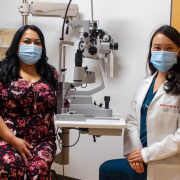
Three years ago, an outside clinic diagnosed Maria Contreras with keratoconus, a degenerative eye disease that causes thinning and bulging of the cornea. Though the clinic followed her for years, Maria saw no improvement in her vision and continued to suffer from poorly corrected irregular astigmatism, a lack of depth perception, and significantly decreased vision in both eyes. Her deteriorating vision was affecting her daily activities, especially at night. She was even told by her doctor that she might have to give up her driver’s license.

“Eventually, I knew their treatment wasn’t working and I needed to do my own research,” Maria said. “There had to be other options for me.”

A friend, who’d received treatment for a similar condition at the USC Roski Eye Institute, recommended that Maria schedule a consultation with Dr. Gloria Chiu. Dr. Chiu is an optometrist who focuses on prescribing specialty contact lenses for various eye conditions, including keratoconus. Although the prevalence of the eye disease ranges from about 1-4% globally, a high volume of patients who seek care and treatment from Dr. Chiu have this condition.

With Maria’s diagnosis established, Dr. Chiu learned that Maria had only been prescribed glasses to correct her vision. “This surprised me because for many keratoconus patients, glasses don’t work adequately once the condition becomes more advanced and the eye shape has become distorted,” said Dr. Chiu. “This is when specialty contact lenses or scleral lenses are required to best correct the vision.”

Dr. Chiu at first fitted Maria with rigid gas permeable (RGP) contacts, and although Maria’s vision improved, she remarked that the bulky lenses were uncomfortable. “I felt like I had an eyelash stuck in my eye,” Maria recalled.

Dr. Chiu then presented Maria with another option, PROSE treatment. PROSE (or: Prosthetic Replacement of the Ocular Surface Ecosystem) utilizes a special software program to create scleral devices that are customized to match the unique contour of a patient’s eye.

“The moment I put them on, I started to cry,” Maria said. “I knew this was something amazing.”

Read the full article and learn how PROSE helped Maria at Medical Express here.


https://www.bostonsight.org/wp-content/uploads/2026/06/how-a-specialty-contac.jpg 683 1024 michele /wp-content/uploads/2026/05/bostonsight-logo.svg michele2021-06-24 12:20:182021-06-24 12:20:18How PROSE Restored a Patient’s Sight

BostonSight Board Member, Kate Weingarten, Receives Lifetime Achievement Award from Westchester Children’s Association

June 4, 2021/0 Comments/in In the Media/by michele

On June 3, BostonSight Board Member Kate Weingarten was honored with a Lifetime Achievement Award from the Westchester Children’s Association (WCA). She has been passionate aboutKate Weingarten headshot helping children and youth in the Westchester community for decades. As a longtime member of the WCA board, she helped the organization build a solid foundation that allowed WCA’s leaders the flexibility necessary to create an effective and visible advocacy program for Westchester’s kids. She played an instrumental role in starting Keeps, an afterschool program for K-6 grade students in Mamaroneck that still supports children in the area. She recognized that having a safe haven for children was essential with so many parents in the workplace.

“Kate has been an outstanding supporter of WCA; I can recall her going the extra mile in our advocacy work to help improve the County’s Invest in Kids funding process,” said Ann Umemoto, Board Chair. 

This year’s WCA honorees also included Secretary Hillary Rodham Clinton with the Edith C. Macy Award for Distinguished Service; and Greater Hudson Valley (NY) Chapter of The Links, Incorporated and Westchester County (NY) Chapter of The Links, Incorporated with the Children’s Champion Awards.  

Kate is an avid volunteer and supporter of BostonSight. She has been a BostonSight patient since 1994 and joined the BostonSight Board in 2013 where she serves as Chair of the Governance and Nominating Committee and as a member of the Finance and Audit Committee, helping to provide strategic direction on the financial health of the organization. She is also a long-time supporter of BostonSight’s fundraising efforts as well as being a regular donor.  

The BostonSight Board of Directors and staff congratulate Kate on this outstanding award.  

https://www.bostonsight.org/wp-content/uploads/2026/06/SquareLogo-Full.jpg 1233 1233 michele /wp-content/uploads/2026/05/bostonsight-logo.svg michele2021-06-04 10:05:572026-06-18 11:10:50BostonSight Board Member, Kate Weingarten, Receives Lifetime Achievement Award from Westchester Children’s Association

Research Indicates Alcohol Consumption Affects Dry Eye

June 1, 2021/0 Comments/in Blog Posts/by michele
BostonSight® PROSE patients with dry eye are advised to follow home-care strategies in addition to their medically prescribed treatment plans to alleviate symptoms. Some of these self-care treatment protocols include taking frequent breaks from computer time, increasing humidity in the home or workplace, and protecting the eyes from wind and sun. Another key component is staying hydrated, which includes limiting diuretics, substances that reduce the amount of fluid in the body. Alcohol is considered a diuretic and thus it is often recommended to limit or avoid alcohol consumption to prevent dry eye symptoms.

Research

Oral alcohol administration disturbs tear film and ocular surface

Researchers at the Hallym University College of Medicine in Seoul, Korea, conducted a small study to look at the effects of alcohol on tear film and ocular surface. Half of the study subjects consumed alcohol while the other half abstained. In the group that consumed alcohol, researchers noted tear film break-up time (TBUT) was significantly greater. In addition, ethanol was secreted into the tears which induced hyperosmolarity, a condition in which greater concentrations of proteins and electrolytes are found in the tears. Hyperosmoloarity is an indicator of ocular dryness and a feature considered common to dry eye disease. Hyperosmolarity can cause the outer layer of the eye’s surface (the epithelium) to become damaged, resulting in exacerbating dry eye issues including blurry vision, discomfort, inflammation, and redness. Based on these study results, the researchers concluded that these changes could worsen dry eye symptoms in patients with ocular surface conditions. Alcohol Consumption and dry eye syndrome: a Meta-analysis In this study that appeared in the International Journal of Ophthalmology, the authors concluded that “the pooled results of the 10 involved studies from 8 articles showed that alcohol consumption could increase the risk of DES [dry eye symptoms]. For heavy drinkers, peripheral neuropathy caused by alcohol consumption may decrease their corneal sensitivity, and the real severity of DES tends to be underestimated, which should draw the attention of ophthalmologists. For any disease, the key point is to cure the disease by understanding and addressing the underlying source. Our findings indicate that controlling alcohol consumption may help to reduce DES prevalence.” This post is part of BostonSight’s archival content and was originally authored by Janice M. Epstein in 2015. Content has been updated to be current.  This content is informational in nature and should not be considered medical advice. Please reach out to your medical professional for questions about your vision.   
https://www.bostonsight.org/wp-content/uploads/2026/06/alcohol-e1622562063949.png 718 1080 michele /wp-content/uploads/2026/05/bostonsight-logo.svg michele2021-06-01 15:41:152021-06-01 15:41:15Research Indicates Alcohol Consumption Affects Dry Eye

Pages

  • About
  • Clinical Trials and R&D Services
  • Conditions We Treat
  • Contact Us
  • Dry Eye
  • Education
  • Find a PROSE Clinic
  • FitAcademy
  • FitAcademy for Residents
  • FitAcademy Immersive
  • FitAcademy International
  • GVHD
  • Home
  • Keratoconus
  • Manufacturing
  • Needham PROSE Clinic
  • News
  • Notice of Privacy Practices for Patients
  • Ophthalmology Resident Lectures
  • Our Approach
  • Our Partners
  • Our People
  • Our Products
  • Patient Care
  • Patient Information Booklet
  • Patient Resources
  • Patient Stories
  • Pediatrics
  • Post-Corneal Transplant
  • Post-LASIK
  • Practitioner IFU
  • Privacy Policy
  • PROSE Provider Payment Form
  • PROSE Treatment
  • Publications
  • Research
  • Research Studies
  • Sjögren’s Disease
  • Software Platforms
  • Stevens-Johnson Syndrome
  • Technology
  • Terms of Use
  • Visiting Clinicians
  • Ways to Support Us

Categories

  • Blog Posts
  • Clinic Updates
  • In the Media
  • Patient Stories
  • Press Release
  • PROSE
  • SCLERAL

Archive

  • May 2026
  • April 2026
  • February 2026
  • January 2026
  • December 2025
  • November 2025
  • October 2025
  • September 2025
  • July 2025
  • June 2025
  • May 2025
  • January 2025
  • November 2024
  • October 2024
  • September 2024
  • July 2024
  • June 2024
  • May 2024
  • April 2024
  • March 2024
  • February 2024
  • January 2024
  • December 2023
  • November 2023
  • October 2023
  • September 2023
  • July 2023
  • May 2023
  • March 2023
  • February 2023
  • December 2022
  • November 2022
  • October 2022
  • September 2022
  • July 2022
  • June 2022
  • May 2022
  • April 2022
  • February 2022
  • January 2022
  • December 2021
  • November 2021
  • October 2021
  • September 2021
  • August 2021
  • July 2021
  • June 2021
  • May 2021
  • April 2021
  • March 2021
  • February 2021
  • January 2021
  • December 2020
  • November 2020
  • October 2020
  • September 2020
  • July 2020
  • June 2020
  • March 2020
  • Patient Care
    • PROSE Treatment
    • Find a PROSE Clinic
    • Conditions We Treat
    • Patient Stories
    • Patient Resources
    • Pediatrics
  • Technology
    • Our Products
    • Software Platforms
    • Manufacturing Lab
  • Education
    • Visiting Clinicians
    • FitAcademy International
    • FitAcademy for Residents
    • FitAcademy Immersive
    • Ophthalmology Resident Lectures
  • Research
    • Clinical Trials and R&D Services
    • Research Studies
    • Publications
  • About
    • Our Approach
    • News
    • Our People
    • Partners
  • Needham PROSE Clinic
  • Donate
  • Contact Us

© 2026 BostonSight. All rights reserved.

Privacy PolicyTerms of Use

Scroll to top Scroll to top Scroll to top
This website uses cookies to improve your experience. We'll assume you're ok with this, but you can opt-out if you wish. Cookie settings ACCEPT
Privacy & Cookies Policy

Privacy Overview

This website uses cookies to improve your experience while you navigate through the website. Out of these cookies, the cookies that are categorized as necessary are stored on your browser as they are essential for the working of basic functionalities of the website. We also use third-party cookies that help us analyze and understand how you use this website. These cookies will be stored in your browser only with your consent. You also have the option to opt-out of these cookies. But opting out of some of these cookies may have an effect on your browsing experience.
Necessary
Always Enabled

Necessary cookies are absolutely essential for the website to function properly. This category only includes cookies that ensures basic functionalities and security features of the website. These cookies do not store any personal information.

Non Necessary

Any cookies that may not be particularly necessary for the website to function and is used specifically to collect user personal data via analytics, ads, other embedded contents are termed as non-necessary cookies. It is mandatory to procure user consent prior to running these cookies on your website.

Save & Accept